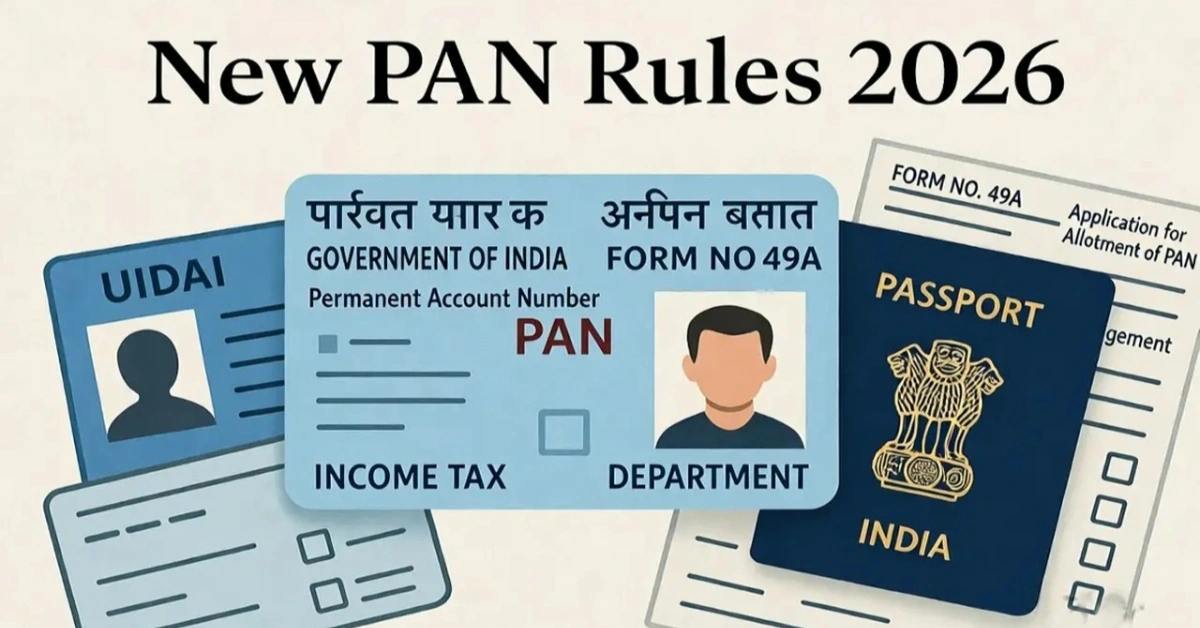
Post Office New PAN Card Rules 2026: The use of the Post Office in the management of money has long been thought safe and convenient to millions of Indians. Starting with savings accounts, fixed deposits, and small savings schemes, people trust Post Office services to make secure investments. Yet, there has now been a significant change in the rules, and it directly affects all account holders.
The new rules on Income Tax that were introduced in 2026 have made PAN cards mandatory in most of the Post Office financial transactions. You might now be required to give your PAN details, whether you are depositing money, withdrawing funds, opening an account or investing in a savings scheme.
Why has the Government come up with this Rule?

These changes have been introduced by the government in order to increase financial transparency and maintain better records of large transactions taking place in the Post Office network.
The revised rules in Section 159,160,161,211,237 of the Income Tax Rules, 2026, will ensure that the details of the PAN are used more accurately to monitor the financial activities. It is also likely that this step will decrease tax evasion and enhance accountability in savings schemes.
In the past, it was possible to have many small transactions without strict verification of PAN. However, due to the increasing significance of digital tracking, the government is restricting the documentation process.
Transactions in which a PAN Card is required now
The new regulations will govern some typical Post Office services, such as:
- Setting up a Post Office savings account.
- Making or removing deposits.
- Fixed Deposits (FDs)
- Transactions under small savings schemes
- India Post Payments Bank services.
When no PAN details are provided where there are requirements, the transaction process might be delayed or restricted.
What in Case You lack a PAN Card?
The government has also offered an alternative to those who have yet to obtain a PAN card.
These persons will now be required to fill out Form 97 as opposed to the normal documentation process. This form requires:
- Name and address of the depositor.
- Type of the transaction.
- Helping with identity and verification papers.
The Post Office will keep such records that even when transactions are made without the use of PAN, transactions can still be properly registered under the tax system.
Big Change in Forms 15G and 15H
The other significant change has been brought in terms of TDS exemption forms.
Previously:
- Form 15G was submitted by individuals below 60 years
- Form 15H was used by senior citizens
Both these forms are now in a successful amalgamation into one document entitled Form 121. This new form should be filed annually by qualified taxpayers whose estimated taxable income is zero. The purpose is to streamline the process of filing and make it less confusing to account holders.
The Effects of This Change on the Common Citizens

To a typical Post Office customer, this update can only be translated to mean that documentation will be of more significance than ever before. Individuals with existing PAN cards might not experience significant problems, but lacking a PAN might require people to fill in additional information.
Experts expect such changes to ultimately bring about a more organised and transparent financial system. Nevertheless, rural clients and older adults might need some assistance in comprehending the new rules and forms.
Frequently Asked Questions (FAQs)
1. Does the PAN card become compulsory in all transactions of the Post Office?
Various key financial transactions, including deposits, withdrawals, opening of accounts and investment in fixed deposits, are now obligatory through the use of a PAN card.
2. What is Form 97?
Form 97 is used as an alternative to those who do not have a PAN card. It gathers identity and other transaction-related information.
3. What is Form 121?
Form 121 is the new combined form to claim TDS exemption instead of Forms 15G and 15H.
4. Who needs to submit Form 121?
Taxpayers with an estimated taxable income of nil and who do not wish to be subject to TDS deductions on interest income must submit Form 121 at the end of every financial year.
5. What was the reason behind these changes?
These rules were implemented by the government to enhance transparency, track high-value transactions, and minimise tax evasion.
Disclaimer: The article is anchored on publicly available reports and updated information on the Post Office and Income Tax Rules, 2026. The rules and implementation procedures can vary with time. It is recommended that readers should check information by official government announcements or consult officers of the authorised Post Office before they make financial decisions.
Also Read:
CM Yuva Yojana 2026: Get Interest-Free Loan up to ₹5 Lakh to Start Your Business
PM Kisan 23rd Instalment 2026: Check ₹2000 Payment Status, Date And Eligibility
DA Hike 2026: Bank Employees Get Salary Boost as IBA Raises Dearness Allowance to 25.70%